For those who prefer it in parts - Here is the post as Part 1 and Part2..........
During the winter holidays, we went home to Chennai. Generally, we tend to remain at home, only visiting relatives and a little shopping. So this time, we decided to go on at least one out of town trip. So we decided on Madurai, Rameshwaram and Kanyakumari. Plan was to go to Madurai, followed by Rameshawaram and Kanyakumari. However, we had to return from Madurai as there was a cyclone warning and we were informed that all tourist activities would be curtailed. Incidentally, the cyclone warning lasted for exactly two days, that is the days of our visit. It was bright and sunny the day we reached back Chennai.
Madurai is the second largest city in Tamilnadu. In many ways, Madurai is to Chennai what Mumbai is to Delhi. It is considered the cultural centre of Tamilnadu. It is also an important industrial and educational hub.
The recorded history of Madurai goes back to the 3rd century BC and is one of the oldest continuously inhabited cities in the world. The city was mentioned by Megasthenes, the greek ambassador to India and as well as the famous Kautilya. The city is closely associated with the Tamil language and the Tamil Sangams (assemblies of famous scholars and poets) which were held here.
The city has been ruled at various times by the Pandyas, Cholas, Madurai Sultanate, Vijayanagar Empire, Madurai Nayaks, Carnatic Kingdom and finally of course, the British in 1801.
We arrived at Madurai by train early in the morning and took a room in the TTDC hotel. it was good value for money, with neat and clean rooms. We quickly freshened up and headed for our first stop, the Madurai Meenakshi Temple.
On recommendation of a Madurai resident, we went to the Murugan Idly Shop for breakfast. The shop which started in Madurai, now has branches in Chennai and SINGAPORE???? and opening soon in DUBAI??!!
We ordered his signature dish, the idly....and it was worth it. White,
light and fluffy. Not a great looking place, but neat and clean. You
will have to eat on fresh banana leaves, thambi style. And he does not
serve coffee in the morning, so you will have to have coffee elsewhere.
But it is very conveniently located - just 200 mtrs from the
temple entrance. So you can come here and have breakfast before walking
to the temple.
Madurai Meenakshi Temple
The most important landmark of the city is the Madurai Meenakshi Temple. The entire city is planned, as a series of quadrangles, around this temple. Meenakshi, to whom this temple is dedicated, is another name of Parvati, Shiva's consort (Info for the occassional non-indian reader). Shiva, in this temple, is known by the name Sundareshwarar. Unlike other Siva temples in South India, the principal deity is Meenakshi, and not Sundareshwarar.
The Story of Meenakshi
(Source : Wikipedia)
Meenakshi, which means fish-eyed, by one retelling, was born to Kanchanamalai, the wife of the second Pandyan king. The girl was born (or appeared out of the holy fire of a yagna, depending on the source) had three breasts. A voice from heaven announced that the third breast would dissappear when she meets her future husband. She was named Tadaatagai and was trained as the heir to the throne. On attaining age, she waged war in three worlds and conquered Brahma abode (Sathyaloka), Vishnu's abode (Vaikuntha) and Devas abode (Amaravati). She then attacked Shiva's abode (Kailasha), where she easily defeated Shiva's army (Bhootaganas) headed by Nandi. She then headed to attack Shiva. But the moment she looked at him, she couldnt fight and bowed her head down in shyness. Her third breast also vanished. She immediately realised that Shiva was her destined husband and she was an incarnation of Parvati. Both returned to Madurai and the king arranged the coronation of his daughter followed by her marriage with Shiva.
The marriage was the biggest event on earth with all gathering in Madurai. Vishnu, the brother of Meenakshi, was to preside over the marriage. However, he was tricked by Indra and was delayed. (More on this soon) After marriage, they ruled over Madurai before assuming their divine forms as Meenakshi and Sundareshwarar.
(Source : Wikipedia)
(Source : Wikipedia)
As an enactment of this tradition, every evening, before the temple closes, the image of Sundareshwarar is carried by a procession led by priests and musicians to Meenakshi's bedroom to consummate the union. He is taken back at dawn.
In many ways, the beauty of Hindu mythology is the sheer diversity of it. Each story can be found, with small and large variations, in different sources. Each city, locality, community would have a variation of the story, passed down over generations by word of mouth, which speaks to them. Every temple and shrine would have a story which in some way would be connected to the main thread. For example, the delay in Vishnu's arrival for the marriage is a story by itself and gives divine authority, so to say, for the existence of two more large temples in Madurai.
Temple Architecture
The temple is believed to have been originally built by Indra for Shiva. Tamil literature as well as saints have mentioned this temple over the last two millenia. The temple is believed to have been sacked by the muslim invader, Malik Kafur in 1310 and all the ancient elements were destroyed. The temple was then rebuilt in parts between the 13th and 18th centuries. The major building work was undertaken by the Nayak Kings, with substantial expansion by Thirumalai Nayak between 1623 and 1655.
The Meenakshi temple in many ways represents the apex of south indian style of temple architecture.
(Source : Wikipedia)
As can be seen above, the entire complex, which is spread over 45 acres has various Gopurams, shrines, mandapams and a tank.
Gopurams are the huge towers, covered with colorful images, that act as gateways. The complex has a total of 12, of various heights and age. There are four on the cardinal points acting as entrances to the complex. The tallest, the Southern tower, rises to over 170 feet and was built in 1559.
These gopurams are covered with colorful images, drawn from epics like mahabharata and ramayana, puranas, myths, legends, folklore, etc. These images are not carved out of stone and is not an integral part of the structure. It is made of lime and mortar, and is repaired and repainted every 20 years or so.


The temple has three shrines, for Meenakshi, Sundareshwarar and Shiva in the form of Natarajar. Each of the shrines have their own gopurams guarding them and providing entry. The Meenakshi idol is made of emerald-hued black stone. The Sundareshwarar shrine lies at the centre of the complex indicating that the ritual importance of Meenakshi developed later.

(Source : Wikipedia)

Mandapams are covered halls, supported by pillars. There are various halls, including the thousand pillared hall (with 985 pillars), celestial wedding hall, Hall of eight goddess, dark hall, musical pillar hall, etc. One tends to lose track as each is filled with stories woven into the stone architecture.


Another interesting side story. The Jains were a major community in Madurai by the 7th century. As per legend, the local Pandyan king converted to Jainism to the dismay of his wife and ministers. So they called the Shaivaite saint, Sambandar, to try an reconvert the king to Shaivism. The Jains tried to kill the saint by burning down his house unsuccesfully. The Jains and the Shaivaite saint held various challenges such a the scriptures being thrown into the fire to see which survives, thrown in water to see which floats, etc. And finally under his influence, the king converted back to Shaivism. Then starts the interesting bit. The king told the Jains to convert too. When they refused, he had 8000 of them impaled, in sitting posture, on wooden stakes. This event is mentioned, celebrated and commemorated in narratives by various writers and poets. It is also depicted in frescoes around the Temple pond and in the museum hall. A few of them are shown below. As you can see, the victims, all bald and bearded are impaled and are being tortured by men while birds are pecking at them.
Now for the strange part - There is no mention of this incident in Jain chronicles. The first mention in Shaivite literature is nearly 500 years after the events supposedly occurred. The frescoes were painted in the seventeenth century, nearly a 1000 years later. It is believed by historians that no such event occurred and the legend was created by Shaivites to prove their superiority. That is like announcing to the world that you have committed gross human right violations, without having done anything. Concocting up an imaginary story of having tortured and killed 8000 men, and celebrating and feeling proud of it. What does it tell us about humanity?


And finally the final piece is the holy tank, a must in every hindu temple. The tank is called the Golden Lotus pond as it was in this pond that the golden lotus required by Indra for his pooja bloomed. According to legend, it was a mandatory requirement for any work of tamil literature to be brought to the pond and put in it. If it sank, it was no good. If it floats, it is good literature. I wonder if the poets spent more time selecting the type of material on which to write, rather than on the work itself. Lord Shiva, it seems, granted a boon to a stork, that there would be no fish or any other form of marine life, in this sacred pond. And so it is till today. (Personally I fail to understand why the stork did not want any fish in the pond......what will he eat? Anyways, I am sure it is an interesting story with a temple somewhere dedicated to it)


That just about sums up the temple.
Is it worth a visit. Without a doubt. It is crowded, but manageable. It is slightly dirty, but very clean considering the crowd passing through it. A guide is a must. Without him explaining things, it is impossible to truly see and appreciate the entire complex (that is from a purely tourist point of view).
Ramana Maharishi Self-Realization House
From
the temple, we walked to the childhood home of Ramana Maharishi. He is a revered guru and teacher of Vedanta who
lived from 1879-1950. He is worshipped by thousands, both in India and
the west. The Maharishi first experienced awakening or self-realization when he lived with his uncle in this house. Devotees from
around the world come here to meditate. Nothing to see here if you are
not spiritually inclined. It is a sparsely furnished house with people
sitting in various rooms in dhyana.
Tirumala Nayak Mahal
Next stop - the Tirumalai Nayakar Mahal. Again walking distance from the temple.

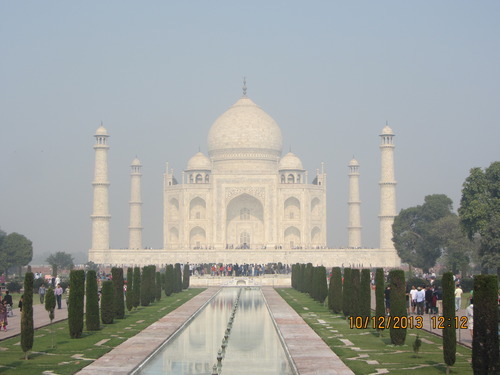
This palace was built in 1636 by King Tirumala Nayak.


1636
ring a bell...? it is the year that the Taj Mahal was built. Looking at
both the structures, one has to marvel at the sheer longevity and
enduring quality of the Taj, which has survived after all these years
without anyone having tried to modify it, break it, destroy it or just use the marble for some
other building plan. After all, this has been the fate of most structures in India.


The
king is believed to have hired an Italian architect to design his
palace. It was built in a blend of Dravidian and Islamic styles. When
built, it was considered one of the wonders of the south. However,
today only the Entrance Gate, the Main Hall and a Dance Hall survive. As
is standard indian practice, the grandson of Tirumala Nayak removed the
jewels, woodcarvings, etc and demolished most of the structure in order
to build his own palace in Tiruchirapalli (a different town). The
British
partially restored it in 1866 and after independence, it was declared a
National Monument.
Today,
it is a constant struggle between the forces of restoration (ASI doing
the best they can, I guess) and the forces of destruction (in the
tourists who love to scribble and carve their names onto every pillar,
wall or sculpture they think is beautiful).
The Palace is not is not grand, but the
limited restoration, including original stucco work, shows how truly
magnificent it would have been in its heyday.
They also have a Light and Sound show, telling the story of Kannagi (a tamil epic). But we couldn't see it.
Tirupparankundram Temple
In the evening we visited Tirupparankundram, a temple dedicated to Subramanya Swamy or Lord Murugan. Like most Murugan temples, it is located near a hill. In fact the sanctum sanctorum is actually inside the hill. The temple is built around the hill in such a way that as we walk further into the temple, you go further into the hill. By now, you would know that the Gopuram you see below is not the temple, but only the gateway to the sanctum sanctorum.

According to legend, Lord Murugan married Devaiyani, the daughter of Indra, here. This temple is considered one of the six main abodes of Lord Murugan.

(Source : Wikipedia)
This is another feature of Hindu temple mythology - all temples come in sets. The number in a set range from 2 to 64. Some are pairs - you have to visit Bedh dwarka when you visit dwarka. There are the 12 Jyotirlinga, 51 Shakti peethas, etc.
At the entrance was an idol of Mahakali, a form of Parvati. We heard the story in the morning in the Meenakshi temple, where Mahakali and Nataraja (Shiva) have a dance competition. They are equally matched. Finally Shiva enacts a pose where he lifts his leg to his ears. But Parvati is unable to do the same due to her modesty as a lady. And so she loses. And she is furious. The sculptures in the Meenakshi temple showed the dance. Here, it is the furious and fierce form of Parvati, as Mahakali, which is depicted. There are guys selling balls of white butter, which you can throw at the deity to calm her down. In my honest opinion, throwing balls of gooey butter at someone who is angry is not a great idea and is unlikely to calm them down. But then the workings of the divine are strange and not for us to comprehend. So I too threw a few butterballs.

Another interesting feature of this temple is that the Shiva and Vishnu idols face each other. Anybody who knows tamil brahminical structure knows that the Iyers (Shaivaites) and Aiyengars (Vaishnavites) DO NOT SEE EYE TO EYE. They have taboos against marriage (you may marry a north indian, but never an aiyengar), have rude jokes about each others habits and rituals, have seperate temples and generally avoid each other to the extent possible. This rivalry can also be seen in the way myths have been modified to show either Shiva or Vishnu as a simpleton requiring to be saved by the other. So image of them facing each other in the main shrine is rare.
From the temple, we headed straight to the hotel, picked up our baggage and had a quick dinner. Thanks to our guide, we were able to savour the other speciality of Madurai - Jigarthanda. Someone, long ago, came up with the
idea of mixing Icecream, China grass and rabri and got a bestseller. in
fact it has become so popular that it has a wikipedia page of it's own
as Jil Jil Jigarthanda. Jil is cold in tamil. Jigar is heart in hindi
and thanda is cold, again in hindi. So the entire name translates to
'Cold Cold Heart-Cold'. In a hot place like Madurai, such a dessert had
to be popular I guess. It tastes just like.....cold rabri with vanilla
icecream. Worth a try, I guess. Go ahead, cool your heart.
After dinner, we headed back to Chennai by the next train.
I was looking forward to my visit to Rameshwaram and Dhanushkodi. Had heard interesting stories, especially about the cyclone which hit the region in 1964. It seems that the town of Dhanushkodi was fully submerged and an entire train with all passengers was washed away. Dhanushkodi, which was an important commercial centre with a railway station and a minor port, was never resettled. Today the only signs left of this town are a church, temple and railway platform.
So that remains a place to be seen another day.




.JPG)


